|
TYPES
OF THEATRE
1. TRAGEDY
- unhappy ending (p136)
- based on the hero’s flaw
- It questions if we have freewill, or is destiny in control?
Example:
Shakespeare's Romeo and Juliet ends tragically with deaths that
were caused by Romeo's impulsive thoughtless actions. He kills
Tybalt, and he and Juliet both die unnecessarily. He claims to
already be in love with Rosaline, and then falls in love at
first sight with Juliet.
Romeo & Juliet with Claire Danes and Leonardo Di Caprio
Music by Des'ree - Kissing You
2. COMEDY – (Greek Word Komoidia)
Comedy of Character – Satire / Ridicule of Individuals (The
Clouds by
Aristophanes, 446? BC-385? BC)
Example -
Dave Chapelle Prince
Comedy of Manners – Satire / Ridicule of Conventions
William
Shakespeare's Much Ado about Nothing was the first comedy of
manners in England.
Example -
Brazil
3.
TRAGICOMEDY -
4.
MELODRAMA -
Plot and action take precedence
over character development. Good triumphs at the
last minute.
Example -
Taken
5.
PERFORMANCE ART:
- Influenced by the pop art of the 60's
- a critique of commercialism.
- controversial and rebellious
Examples -
Frozen At Bus Stop (a happening)
Human Art
Buddha With 1000 Hands
China Disabled Peoples
Performance Art Troupe
Kathy Rose/Oriental Interplay
Kathy Rose/Syncopations
Kathy Rose/Excerpt Queen of the Fluids
6. MUSICAL
Example
-
Moulin Rouge
-
Cats
-
Jesus Christ Superstar
STAGE TYPES
LIGHTING
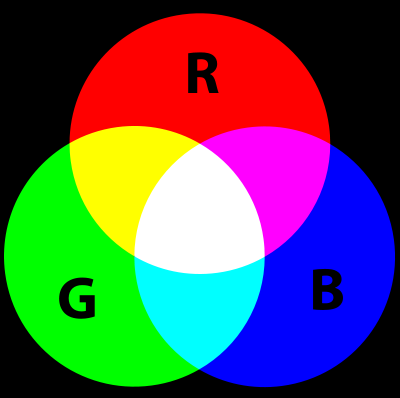
Additive Color Mixing
-
The color theory we studied is called subtractive
color where red, yellow, and blue are the primary
colors. We mix those colors to create the other
colors. With additive color we mix different colored
lights. We mix red, green and blue light to produce
the other colors; these are the primary colors.
Combining two of these colors in equal amounts
produces an additive secondary color. Blue light
plus green light produces cyan. Magenta is created
by mixing red and blue in equal amounts, and yellow
is the result of mixing green and red light.
Combining all three primary colored lights in equal
intensities produces white.
-
-
Lightness
- light verses dark
-
Saturation
- the intensity of color
-
Hue
- another word for color
Red, orange, yellow, green, blue, and purple are all hues.
On the Magic of Theatrical Lighting
David Hockney
COSTUME DESIGN
Lion King London
Tony Award Winning
Lion King
Music by Elton
John, lyrics by Tim Rice, director and
costume design by Julie Taymor.
Julie Taymor on TED
Official Site
cirque du soleil
Parade the Circle /
2004
Hans Silvester:
Omo People:
Slides |
Otra Vez |
African Tribal
VERISIMILITUDE -
In order for a piece of art to hold
significance or persuasion for an audience,
according to Aristotle, it must have grounding in
reality. See the
Poetics by Aristotle
- Translated by S. H. Butcher
(e-book)
French Academy of Languages censured drama and
literature. It had to be:
-
True to life - as things could happen - not did
happen (Titanic)
-
Moral with no surprises
-
No violence onstage
THEATRE APPRECIATION
Doubt by John Patrick Shanley
-
Pulitzer
Prize Winning Drama
ONLINE BOOKS
-
Romeo and Juliet by William Shakespeare
-
Poetics by Aristotle - Translated by S. H. Butcher
|